Friday, 4 March 2016
Arsene Wenger and what Arsenal teaches us about history
For an Arsenal fan, it's been the same for the last 12 years. The expectation, the anticipation, the inevitable disappointment. The one player left standing alone on the pitch who has carried our hopes for the season, frustrated and helpless. The same advice is thrown about every year: Buy, spend more, build a squad. After a few weeks the hype dies and no-one of significance is added. Back to the youtube videos of Bergkamp and Henry, remembering the good old days at the turn of the century. We never seem to learn.
Maybe we just can't learn from the past? But I refuse to accept this position. The reason I believe we can is that our collective knowledge is not incremental. Whilst in science and medicine, change has been consistently improving (even if for sometimes random reasons), it is mistaken to think this applies to the rest of life. Are we happier, more fulfilled and better people than those who lived 500, 1000 years ago? It doesn't seem so. Not that things are necessarily worse now, that would be equally misleading to suggest, but that it seems that each era has its thing, its area of strength that gets forgotten by subsequent generations.
I often think that when I go into a library. It hits you - there are thousands and thousands of books here, how many have people actually read? How much of their knowledge and insight is lost forever? Has internet access made us wiser or simply lazier?
In studying rabbis who lived around the time of what is known as the 'Renaissance' period, I have encountered the idea of using history and find it fascinating to apply to our own society. Renaissance literature, architecture and paintings were geared around a vision for the betterment of the world based on learning from the knowledge of the ancients, a general optimism about the role of man in the world and his ability to spread values that would improve society. Knowledge wasn't simply for the elites in the academy, it served a broader purpose. One theory went, that by looking and living around things of beauty which promoted good values and ideals, society would become a more peaceful, moral and harmonious place. Paintings of classic Christian figures stopped looking austere and frightening and started looking human and compassionate.
Buildings in Italian cities are brilliantly symmetrical, with arches and courtyards, with many 16th century books written on how architecture should be designed to enable, for example, a mother to shout out a window to her child playing outside so he could hear.
This is just one important lesson we can find in historical annals, the power of both the visual and emotional stimuli to envision a better society. So as an Arsenal fan I look back to Dennis Bergkamp, Robert Pires and the gang and remember the days when beauty and success went hand in hand.
The Jewish world has been enormously affected by the Enlightenment and the triumph of Science and reason in the 18th and 19th Centuries. Even today, many discussions are framed in terms of the rational as opposed to the irrational in religion. But it hasn't really developed a renaissance-like mindset in the same way - there was not a movement comparable to the one in the Christian world (not an unconstested view). It was clearly more difficult when we were a minority with little financial independence but it would be an interesting question as to whether some of the more romantic and idealistic conceptions of the past using visual media could be appropriated by Jewish leaders in their visions of building a more harmonious Jewish society.
Friday, 26 February 2016
Car Journeys from hell: Can we enjoy life without guilt?
Have you ever turned around and felt that guilt is far too dominant as a basis for religious life? I believe it is a product of the compartmentalised book mindset I discussed last week. The following story is a case in point from one of the most awkward car journey moments I have ever had:
It happened about four years ago; two of my friends and I were in a car with a particular rabbi, animatedly discussing an issue that bothered us about our responsibilities in Jewish outreach. All three of us were very passionate about the subject and enjoyed the opportunity to address these issues with someone older, wiser and more experienced. But at one point the rabbi stopped and turned to us with the following question: Well, we've discussed that topic - now what's everyone been learning - do you have a sefer to learn from or a D'var Torah?
The three of is froze, awkwardly. We stayed silent for about thirty seconds. Slowly, I produced a book that I happened to be carrying and started reading, agonisingly, for about ten minutes. It was awkward, painstaking and completely artificial. The rabbi smiled indulgently whilst the three of us sat there feeling mildly humiliated and guilty. The subtext was clear: "You're frum, you should be discussing words of Torah. If you aren't, you're not doing very well are you?". The perfect guilt trip and an illuminating window into the minds of our teachers.
This story has stuck in the mind as the thing that irritates me most about how most informed and educated people understand religious observance and their inability to see it holistically.
But I must approach this with a degree of humility. Perhaps I am not correct; perhaps every action I do does need to be based upon an underlying basis to be considered appropriately religious, a means to an ends. It may not be enough to enjoy something and I may think along these lines as a form of self-legitimisation. But it raises lots of questions:
For example, even in the minds of those who associate with the 'Modern Orthodox' mindset, is personal development a religious end in itself or only inasmuch as it makes me go to shul more, pray with more concentration or learn more Torah?
This week's parasha reminds me of this point. On the one hand, we have the golden calf - condemned as the deceptive intermediary between man and God, preventing the pure relationship between God and His people. In sermons this is often extended to all material goods and pleasures - be careful not to make them into a golden calf. But it is also interesting to read the ornate descriptions of the mishkan and the garments of the Kohen that surrounds this parasha. I know the discussions surrounding the relationship between the two but what if people forgot to make the link between lofty elevation of divine service and the nice shiny looking objects? They might have had an off day and then it's cow time again. Shouldn't that be avoided too?
Sanctify the mundane for holy purposes but don't let it escalate - a very thin line. It leads me to something I have thought about a lot recently: Does Judaism require me to link everything I value directly to God or not? Could I gaze at the garments of the Kohen, for example, dazzled by their splendour and enjoy their beauty or would I need to say - Wow, what an amazing creation of God's?
It is the question of whether God can or should be found in the immediate situation and experience you are encountering even if it is not directly linked to Him. Is it enough to be happy, interested, joyful or grateful? Are these positive, life enhancing sensations inherently Godly? Because personally I think that if they are not, the 'means to an ends' doesn't work very well and guilt will prevail. And if they are they should be discussed far more.
You see, when you go off to work or university thinking that the primary expression of being religious is the active involvement with a gemarah or a positive fulfilment of commandment x or y then the following scenario will occur time and time again, and it has nothing necessarily to do with the great appeal of the outside world or its temptations:
You start by happily thinking along the lines you have been taught: Look forward to the mincha, to the learning later, to the providing of a parnassah for your family. But then you find that you begin to enjoy other things. Things that don't seem prohibited but that don't seem obviously religious. Maybe it is the work, the social interaction with colleagues or just being involved in a Jewish society at University...
Then a little gremlin taps you on your shoulder saying: Shouldn't you be learning? Are you doing this for the right reasons ie. so that you can sustain something else which is actually important? Yes, that makes this important by extension but it doesn't feel that way. It becomes a competition for attention between 'you' as you see yourself and 'you' as you are supposed to want to be. Some would call it cheshbon ha nefesh. Others would say it's a lifetime guilt trip. Something's gonna give and guess what? It's rarely the thing you actually enjoy.
And somewhere along the way, the music starts to fade. Because God is only found in the 'other' thing.
In future posts I would like to link this discussion to the topic of 'Shleimut' or 'completeness' found in the writings of medieval and early modern Jewish writers linked to an ideal of personal development very similar to that found in renaissance thought.
Wednesday, 17 February 2016
Why books make you foolish: Lessons from Harry Potter.
'Never trust something if you don't know where it keeps its brain'. In Harry Potter and the Chamber of Secrets *SPOILER* Arthur Weasley reprimands his daughter Ginny for allowing herself to be lured into writing to an invisible stranger within a diary who turned out to be the young Lord Voldemort. Voldemort ended up possessing Ginny and were it not for Harry and Ron's heroics, would not have lived to tell the tale.
In studying Jewish texts we often don't know the brain behind the books or particularly care, either. If we study a work of halacha, a view and discussion is presented detached from life, background and personality of the people who wrote it. Some argue that this doesn't matter, it is the points that count. But to me it does - particularly when we take life lessons from the books.
How do we translate words from a page into daily life that we experience at every given moment? If we take the words too literally we can find them utterly disconnected from anything that we experience in our own lives and it is this problem that I believe lies at the heart of much rabbinic and religious leadership today - an inability to understand two domains simultaneously: The penetrating, careful and loyal engagement with our religious texts and a deep understanding of real human life; the ability to see both domains as crucial to a vibrant religious existence.
What do I mean? In Judaism our books are the source of our wisdom. Many sermons will start along the lines of : 'It says in Sefer/book x, Gemarah y etc.' But quoting a book will never enable us to gauge the human life element lying behind the words. We know that life is ever-changing, dynamic, complex and can not be reduced to a list of words. How God relates to our ups, downs and hurts can't be read to us dispassionately from a list of sources, irrespective of their sanctity.
I have noticed the disconnect between 'book world' and 'real world' when rabbis or speakers make a generalising joke about women or gay people for example, which makes many of the congregants cringe uneasily. Jokes and attitudes that were acceptable twenty years ago are off-colour today. To be truly respected by people you have to understand how they think and feel.
It may not bother them in the slightest, 'The rabbi was controversial today? Oooh what did he say? etc.' But it shows something is missing in that we have placed religion in a compartment reserved for the texts associated with it - as long as he can tell us if our pans are kosher we'll keep him, as long as he gives a good gemarah shiur etc. The book is there but where is it's brain?
The issue here is that it shows that the rabbi, who represents Judaism, is a figure who isn't associated by his community as possessing a mature understanding of human beings or society.
Too often it seems that the connection between a deep understanding of ourselves, of our place in the world and our relationship with God through the Torah is hidden rather than magnified by teachers educated in the (usually) Yeshivish world of books. Quotes - tick. Knowledge of religious material - tick. Wisdom? Insight? That's for the psychologists, for the famous scientists, maybe a particularly kind of one-in-a-million rabbi who writes famous books and does world tours. Or alternatively, 'Go and look in a mussar book for that or listen to Kiruv rabbi x!'.
Sources, sources. We love our sources. Text-based shiurim are contrasted to airy-fairy fluff. But sources are only as insightful as the one reading them, and the extent they can grasp the concepts and relate them to the broader understanding of where the source is coming from. There is so much 'Rabbi x said this Rabbi y said that' that we act as though the whole life of that person can be summarised by a line that they may have written (probably misquoted and out of context) in a book somewhere.
But we know that if we were in the same position and that's all people thought about our lives we would be very disappointed. It would be like building a profile of ourselves from our text messages or tweets. Sometimes its better to put the books down before we lose ourselves too much in a world built entirely of them. Otherwise we may end up speaking to Voldemort and not even realise it.
Thursday, 11 February 2016
Should we take anything seriously? The ability to laugh at ourselves
WHY SO SERIOUS? THE JOKER
Among Dylan's unique traits apart from being one of about ten people in the last fifty years to be able to write half-decent lyrics was the contempt he showed for journalists. Whenever he was asked about the deeper meaning of his songs he would laugh, smoke a cigarette and reply "I don't know man, you tell me what they mean".
When one of the lefty-intellectual types mentioned something he had come up with as a suggestion or interpretation for what an album might symbolise, Dylan just looked mildly amused and condescendingly congratulated him for his insight: https://www.youtube.com/watch?v=guOaI6_cF10
Whether this makes him the nicest person in the world is besides the point; he couldn't stand how seriously they were taking everything he said. He could laugh at himself. It was a bit ridiculous after all, for every self proclaimed intellectual to use this 'song and dance man' as their icon and hero.
Fast forward fifty years and I find that the only people I find myself wanting to talk to about 'serious' issues are those who don't mind laughing at themselves, as if to say 'yes, who really cares, I could be completely wrong and am a slightly ridiculous person just like the rest of the world'.
Then I can respect them. Because I can see that they have the humility to realise that they are just one person and that there are many views on a particular subject. This shouldn't mean that they should not be passionate, but that it should not escalate to the point where everyone else can be presumed wrong. No this isn't a punt for pluralism. Pluralists are amongst the internet's biggest zealots. It is about a mindset that should precede the expressing of an opinion.
For me, it would be the equivalent of 'I am self-indulgently writing another blog quoting quite pretentious sources left, right and centre under the pretence of some sort of authority' - a sort of leshem yichud before each blogpost ( in-joke, sorry).
I admired a Chabad rabbi who I spoke to recently when he replied to a question of mine by stating that 'Yes, you could see it from another angle, but I am presenting the chabad position on the matter' - I respect that. He could see that his way wasn't the only way but it was the one he believed was true.
Because most conversations about religion and politics are had by those who really think they have a personal right to be listened to. Particularly with these areas, the atmosphere can become bigoted or hostile, or alternatively lots of like-minded people find a strawman to bash e.g. the chareidim or the open orthodox and inevitable schisms in Orthodoxy.
Well, you could turn around and say, of course you have to take these things seriously - sometimes these are matters of life and death or the welfare of individuals and society, these are serious issues. Agreed. They are serious issues. But you getting all serious about them is not going to resolve them any better and will probably mean that they are less likely to get addressed because once you take the 'I'm the serious one' position you have essentially blocked off one side of the argument.
It's like the whole political correctness nonsense that now pervades every University campus. The issues that are debated are all about the feelings and rights of every possible group and minority who might be offended and whilst this is admirable if it prevents persecution it can also become completely intellectually stultifying. You are so busy worried about how many things might offend people that no-one's knowledge is broadened or expanded on any topic whatsoever. It's also no fun.
Parroted words about 'discourse' and 'spaces' and 'conversations' replace challenge and debate. I would know. When I went to a school that wasn't Jewish, I had many conversations about religion which were not always comfortable, and which I didn't always know how to respond. But who cares? chill out! Learn a bit more, explore a bit more, maybe leave your comfort zone. Rome wasn't build in a day, ho ho. Either way, I often wonder if the world would be a better place if world leaders looked in the mirror and said to themselves "Which idiot put me in charge of a whole country?"
Among Dylan's unique traits apart from being one of about ten people in the last fifty years to be able to write half-decent lyrics was the contempt he showed for journalists. Whenever he was asked about the deeper meaning of his songs he would laugh, smoke a cigarette and reply "I don't know man, you tell me what they mean".
When one of the lefty-intellectual types mentioned something he had come up with as a suggestion or interpretation for what an album might symbolise, Dylan just looked mildly amused and condescendingly congratulated him for his insight: https://www.youtube.com/watch?v=guOaI6_cF10
Whether this makes him the nicest person in the world is besides the point; he couldn't stand how seriously they were taking everything he said. He could laugh at himself. It was a bit ridiculous after all, for every self proclaimed intellectual to use this 'song and dance man' as their icon and hero.
Fast forward fifty years and I find that the only people I find myself wanting to talk to about 'serious' issues are those who don't mind laughing at themselves, as if to say 'yes, who really cares, I could be completely wrong and am a slightly ridiculous person just like the rest of the world'.
Then I can respect them. Because I can see that they have the humility to realise that they are just one person and that there are many views on a particular subject. This shouldn't mean that they should not be passionate, but that it should not escalate to the point where everyone else can be presumed wrong. No this isn't a punt for pluralism. Pluralists are amongst the internet's biggest zealots. It is about a mindset that should precede the expressing of an opinion.
For me, it would be the equivalent of 'I am self-indulgently writing another blog quoting quite pretentious sources left, right and centre under the pretence of some sort of authority' - a sort of leshem yichud before each blogpost ( in-joke, sorry).
I admired a Chabad rabbi who I spoke to recently when he replied to a question of mine by stating that 'Yes, you could see it from another angle, but I am presenting the chabad position on the matter' - I respect that. He could see that his way wasn't the only way but it was the one he believed was true.
Because most conversations about religion and politics are had by those who really think they have a personal right to be listened to. Particularly with these areas, the atmosphere can become bigoted or hostile, or alternatively lots of like-minded people find a strawman to bash e.g. the chareidim or the open orthodox and inevitable schisms in Orthodoxy.
Well, you could turn around and say, of course you have to take these things seriously - sometimes these are matters of life and death or the welfare of individuals and society, these are serious issues. Agreed. They are serious issues. But you getting all serious about them is not going to resolve them any better and will probably mean that they are less likely to get addressed because once you take the 'I'm the serious one' position you have essentially blocked off one side of the argument.
It's like the whole political correctness nonsense that now pervades every University campus. The issues that are debated are all about the feelings and rights of every possible group and minority who might be offended and whilst this is admirable if it prevents persecution it can also become completely intellectually stultifying. You are so busy worried about how many things might offend people that no-one's knowledge is broadened or expanded on any topic whatsoever. It's also no fun.
Parroted words about 'discourse' and 'spaces' and 'conversations' replace challenge and debate. I would know. When I went to a school that wasn't Jewish, I had many conversations about religion which were not always comfortable, and which I didn't always know how to respond. But who cares? chill out! Learn a bit more, explore a bit more, maybe leave your comfort zone. Rome wasn't build in a day, ho ho. Either way, I often wonder if the world would be a better place if world leaders looked in the mirror and said to themselves "Which idiot put me in charge of a whole country?"
Tuesday, 2 February 2016
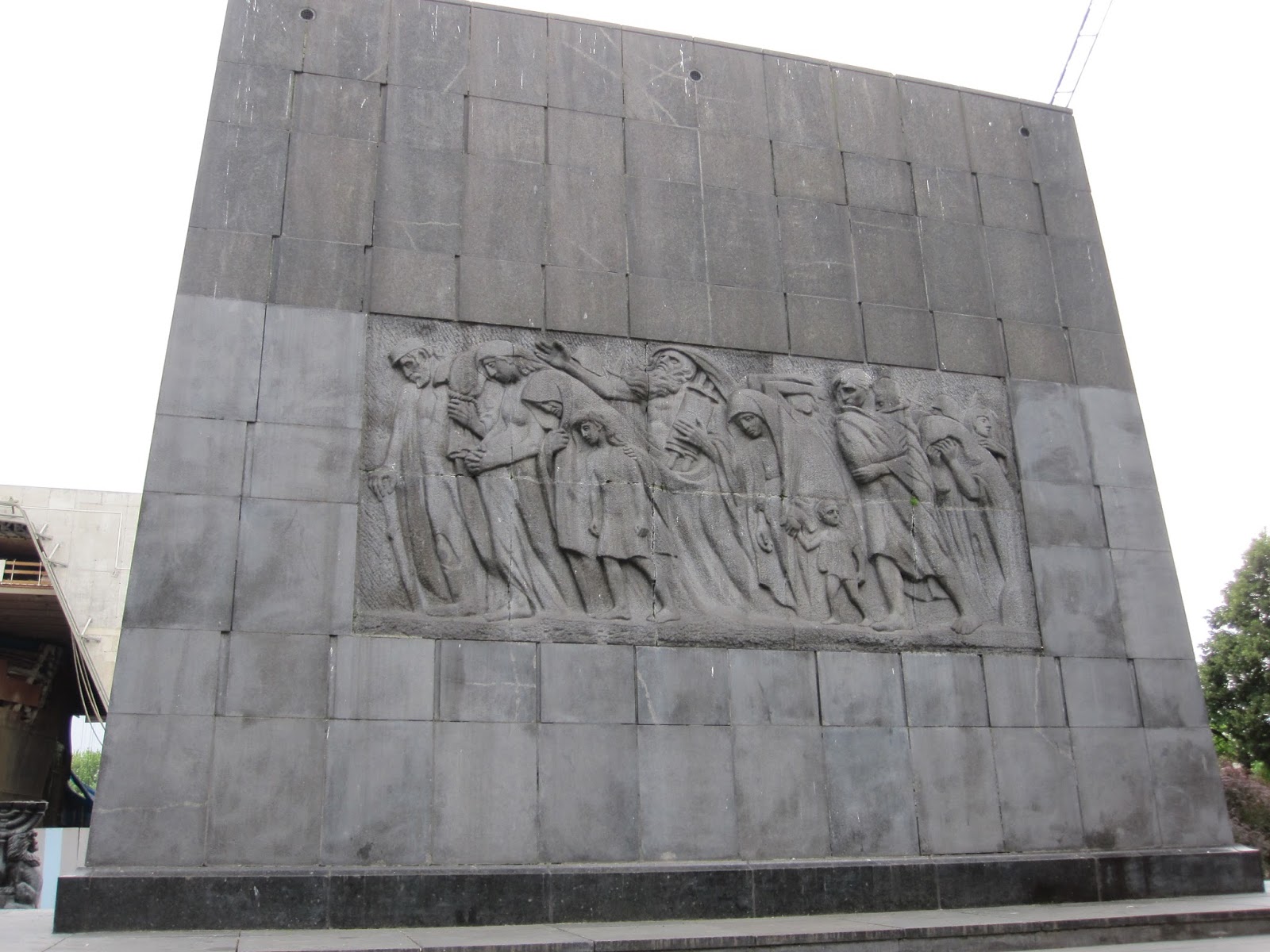
Why do we remember? Memorials, silences and where no words can be said.
Yosef Hayyim Yerushalmi wrote a book compiling his essays on the subject of Judaism and memory in 1982; in it, he argued that academic scholarship and historical 'truth' have been disconnected from popular memory since the 19th Century. Up till then, Judaism saw history as a grand divine narrative, starting with Adam and culminating in the Moshiach. The passage of time was never seen as relevant apart from its religious meaning. Wars, plagues and tragedies were seen as essentially the same thing - a reminder from God to repent. But after the nineteenth century when secular scholars began placing historical events in their own context, the history of religion and the academic scholar permanently divided.
Amos Fukenstein critiqued this position by suggesting that a. It is difficult to describe a people as remembering in one particular way, individuals remember not people ( a classic postmodern critique which is then qualified by mentioning that there can still be many shared traditions and experiences) and this has varied over the centuries with Rambam and renaissance thinkers having more of a 'realist' view of history 2. The German Academics of the 19th century were also writing for a Jewish audience with similar aspirations to themselves, to become emancipated, enlightened and universalist in nature. They shared the popular mindset of the Reformers.
But the overall point remains strong: In classical Jewish sources until the 19th century, the importance of remembering is how to respond to God's signs in history. It is a call to action or a call to repentance. During our fast days which are held on days commemorating a tragedy, we are not told to analyse the details of the day - the kinnot are fairly thin in historical detail - but rather to cry out to our father in heaven for repentance. Memorials and silences out of respect might cause introspection but they do not contain the implication that we must or can do something about this memory.
But then comes Holocaust memorial day. The most difficult of topics to think about. In fact, one of the reasons I have avoided studying modern history is because I simply cannot grasp the enormity of the holocaust in a way which comes close to being detached (Not that any scholar is ever completely detached from their sources but there is definitely a spectrum).
The academic, prosaic mindset can't grasp it. Perhaps here are the borders of scholarship, where data and interpretation must concede that they can go no further. Here, in my opinion, is also an excellent example of the tension between traditional religion and modernity.
Many in the chareidi/ frum world have given speeches over the years about how the ignorant 'secularist' Israeli government insist on making another Shoah day whilst ignoring Tish'a B'Av. The Jewish position, they say with some justification, would be to place the holocaust in the overall narrative of Jewish suffering in history.
But to the modern mind, the indiscriminate systematic and comprehensive evil of the Shoah cannot be simply placed in a system which seems to lay blame on its victims. It can never be justified or understood by adding it to a religious narrative of history, as if this explains it. It cannot be seen as part of something else. To give explanations that focus on punishment seems so short-sighted, cruel and foolish.
And yet religion is significant only to the extent that the individual can have a personal, intimate and unmediated relationship with the divine. A God who loves us.
The mind has reached its limits. Silence now.
Thinking back to various figures who either directly or implicitly told us that we had a duty to do something to preserve the memories of those who were murdered, perhaps you didn't understand that sometimes no words can be said. That sometimes the lessons you taught are cheap and cruelly manipulative and stab us with pangs of guilt. Perhaps you should have stayed silent about that which you cannot speak.
Perhaps I can conclude in my own mind that although as a Jew painful collective memories must be used to stir us to action, sometimes it is up to us to decide the relationship between that memory and our action, for to draw links between the two implying a causal relationship assumes an omniscience that I nor any other human being can ever have.
Wednesday, 27 January 2016
Does Judaism care about the environment and why sources don't tell half the story
It was Tu Bishvat last Sunday. A late addition to the minor Jewish festivals and very associated with Modern day Israel (those of us who were in the Independent will remember the old classics such as 'Tu Bishvat Higiya....') and its agriculture but it got me thinking - if I was a rabbi or teacher giving a nice thought-provoking shiur linked to this day what would it be? Well, trees and fruit so.... Judaism and the Environment! Then I started thinking, well which sources would I use? Something about not cutting down fruit trees in war, the symbolism of a man as a tree of the field and something to do with not wasting resources.
Then I realised the problem with this - I barely think about the environment. Yes, if asked I would say that I try to recycle, I don't litter etc. I definitely should care about things like global warming but does it bother me deeply? No.
So is it reasonable for me to get up and talk to an audience of willing participants about how environmental concerns are fundamental to being Jewish and, after half an hour probably get to the stage where I had everyone convinced that everyone since Moses had aspired to prevent global warming? After an hour I would go home and, without a trace of guilt, not think about it again until I had to give the next talk.
Indeed is it ok to talk confidently about what Judaism stands/ has always stood for? In this instance, a rabbi will often stand up, read off an impressive array of traditional sources on the environment but if we go out to the streets and see who is actually talking/campaigning /acting on these things it is rarely the people giving the shiurim.
No, this isn't a rant about hypocrisy - we all fail to reach our ideals, better to have them in the first place - but it rather highlights the gap between talking about things and actually doing them. This has always bothered me to some extent. Topics such as social action, human rights and universal world issues by and large are the property of the Left, and not particularly associated with Orthodox Judaism, however much sources will seem to tell us otherwise. (This may be culturally ingrained into Ashkenazic Orthodoxy as a reaction to the universalistic and liberal tendencies of the Reform movement, but that is for another time.)
Because it seems that we cannot properly answer the question of whether a religion or group cares about x or y by looking at sources. Of course we can look at our sources, but do we choose to or do we just turn to them every now and again when it is convenient to pay lip service? There are many many Gemarah passages out there, do we assume that every person who subscribes to its sanctity consciously absorbs every teaching? Actively cares about it, regardless of its theoretical truth?
I have always had the exact same problem with the University student culture. For a few years a lot of noise is made about Socialism and world poverty but then they leave and go and work in a bank like the rest of the world, as though they had gone through a teenage phase that had been outgrown. How do we know what people really stand for?
I don't know exactly, but I suggest that the best of way of telling is by asking them to quieten down and see what they do when the fanfare has gone.
Friday, 22 January 2016
Northern Lights and the problem of miracles
Miracles occur throughout the Torah, particularly during yetziat Mitzrayim/ the Exodus. They assume many shapes and sizes but are basically about the fact that God is in control of the world, above nature and has personal concern with the fate of human beings and the Jewish people.
One of the first qualifications used when discussing miracles today is that 'These things happened a long time ago but not anymore' for reason x or y. So if you want to you can put them in the 'don't have to think about it as not really relevant' draw and discuss it as an abstract topic if it arises.
But are they of any importance today? One of the main purposes of the miracle was that it inspired awe of the greatness of God. The problem is that miracles don't sound particularly impressive any more and would be very unlikely to inspire awe. In fact, I doubt they would stir any significant religious feeling whatsoever. Sea split? Cool. Great trick. Google it for an explanation. No explanation? Dno, back to youtube. Others might point out that it is not a compelling argument to suggest that because I can't think of a reason for it now something which can explain it won't come along in a few years, after all gravity, medicine etc...
Miracles, it seems clear from reading the pesukim, are supposed to draw people closer to God, to know Him. But a huge gap would exist today between the stimulus and our response, as lots of incredible, apparently inexplicable things happen all the time with perfectly reasonable explanations. Illusionists such as Derren Brown spend much of their time debunking the miraculous credentials of charismatic religious preachers.
A few weeks ago we went to visit the northern lights. Now that really was incredible, watching these mysterious rays of light dancing across a midnight sky. Of course, there are simple scientific explanations for them but they don't capture that feeling being gently mesmerised and yes, even awe.
It reminded me of something. Religion is often given the function of being a primitive means of explaining phenomena that we don't understand. This viewpoint has been absorbed into the western mindset and is similarly sometimes felt within religious communities. Miracles are seen as possessing a function - proof of that which lies beyond nature. If that reasoning is faulty, their purpose expires.
But it was that awe that I felt at the Northern lights which reminded me of the approach of the Rambam that the power of miracles is not found in their inability to be explained nor their ability to prove or demonstrate. Things that are disconnected from our minds can't penetrate deeply into our lives and can't really help us in our relationship with God.
The power of the miracle is found in the nature of awe itself. It's not something that you experience everyday. When you encounter awe you briefly feel very small and very important simultaneously. Tiny man, insignificant in the face of the vast universe and yet still capable of feats of greatness beyond our size. To me this lies at the heart of miracles; that they are supposed to stir feelings which combine these two perspectives on being a human being. Then, perhaps, we can attempt to approach God.
Often, I find, you need to approach religious matters from a different angle in order for them to remain relevant in your life which after all, is constantly changing.
Saturday, 19 December 2015
A conversation I had with a wise old man and a thank you to all my friends
I had a really interesting encounter with an elderly man last week at Bushey shul. As I was sitting there, minding my own business, he started talking to me. He told me about his life - how he had been evacuated when he was a boy, how he had served in the RAF, how he had met his wife at a local Jewish youth club and how he had spent several years in the fur business before a chance encounter had led him to become a Taxi driver.
But what was so interesting about this man was the fact that he kept saying to me, with a huge smile on his face, 'I have met so many wonderful people in my life'. When I told him that I was getting married tomorrow he said that he had been married for 63 years and that life was all about the ups and downs you encounter and those who succeed in it are the ones who have learnt from the obstacles along the way.
And that really inspired me. Did this man say anything groundbreaking? Nope. But this man had lived. He had seen. He, a complete stranger gave me real insight into how I should see my own life.
One thing I have discovered in the past few years in my own life at least is that many questions of theory are much better answered through experience than through a thought out response.
Where is God in the world? What is my purpose in life? It seems that rather than attempt a reasoned discussion of these issues I have found them to be far better answered in the relationships I have developed and the life experiences I have had. Maybe that's why I was so moved by speaking to that particular elderly man.
And I too, the day before my wedding, think to myself: I have met so many wonderful people. I have had such great friends, experiences and companions. Thank you all.
Thursday, 10 December 2015
Influence, control and abuse: The thin line between charismatic leadership and cult leadership.
I saw a brilliant show by Derren Brown on Saturday night. Without revealing any details, it was an excellent demonstration of how people can be made to think and do things using the power of subconscious influences. I was very impressed by the way he used his particular talents to help people feel better about their problems.
But it also showed that whilst we think we make our own choices, there in fact there are a number of factors that we are unaware of affecting our decisions (I have also started reading the book thinking fast and slow by Daniel Kahanaman which addresses the psychology behind this). More significantly, for me at least, it was also a demonstration of how particular individuals can use their personal charisma to exert an enormous influence over you, to the extent that your personality can become subsumed into theirs. That was quite a scary thought.
It also reminded me of something that I often think about when listening to popular public religious speakers and from my own experiences with charismatic individuals. How much am I being influenced by the show behind the individual's speech? It is almost impossible to disassociate the person, the climate and the feel-good effect from what is actually being said.
I remember vividly in sixth form coming home one shabbos to announce that I had heard the most incredible D'var Torah by a well known speaker in the community. 'What did he say' My Dad asked. Hmm I thought. Hard to really put into words. So I tried, and I realised that its content could be said in about ten seconds but I made sure to follow these words with 'You just had to be there, you don't understand'.
So what? You might say. Ostensibly, we are not simply drones who respond to content alone. Personality certainly becomes a part of any method of communication. But there is a more sinister element to all this. That is the question of control. Using Derren Brown-esque skills a spellbinding speaker or personality can make us do things that if we detached ourselves from the situation we would not consider. Unfortunately I can attest to personal experience in this regard.
They can make us think thoughts that, in many ways are not our own. And then we can easily lose sight of the difference between who we are and who the person who is our boss, teacher, rabbi, role model is. And in the hands of the wrong people this can lead to an extremely dangerous relationship.
There was a sad story in the news the other week about the young Conservative party member who committed suicide, seemingly after encountering horrendous bullying from his peers. Clearly, to some, the pursuit of power is a singular one which can disregard the consequences of its actions, taking advantage of someone's willingness to obey your every instruction.
The fact of the matter is that it is often people with the potential for this sort of manipulation often find themselves in positions of leadership. If the organisation in question has a particular agenda it is very easy to create a climate under the complete control of this personality.
It is certainly something to think about when you enter a position of some sort of power particularly in areas which have deep emotional sway over people such as faith. People will see you differently. You might be able to have them under a spell of sorts. You may be able to make them do exactly as you want. And to be conscious of the extent of your standing is to also be aware of the fine line between positive influence, control and even abuse.
To educate is to channel not to manipulate. This applies even if we are convinced about the rightness of our message, method or agenda; for if we don't respect the dignity of each human being and their ability to make up their own minds about things we run the risk of crushing them, scarily, without even meaning to.
Thursday, 3 December 2015
Getting married and why we shouldn't answer questions
The old world is rapidly aging. Please step out of the new one if you can't lend a hand for the times they are-a-changing.
Oh boy they are - I'm getting married in two weeks! As well as that being incredibly exciting the enormity of it all also means that it is quite overwhelming. There is always a challenge in facing a change in our lives that represents something unknown, regardless of how much we look forward to it. If there is one thing that we humans fear, it is the unknown. In fact, the whole of historical study grapples with the question: Why did it change? How did we get from caveman to facebook? Changes always pose the question of how we should respond to our new circumstances in, for example, jobs, relationships and health. It leads to so many questions and so many unknowns.
It is tempting and comforting to think that we can find the answers to deal with change and the future and apply them like bandages over the wounds of uncertainty - 'I'm scared mother make it go away.' And it is this issue that I think of when I consider how religious teachers in the Jewish world approach questions in general.
In popular books and Shiurim there is a glowing confidence that all your questions can be answered if you only know who to ask. What's the problem with the ultra chareidi schools, they ask? They don't let kids ask questions, so they go off the D. Let us establish a model where kids are free to ask questions which we can provide with good answers so that they'll be fine. More than that, they claim that unlike other religions such as Christianity, Judaism encourages questions. This was a frequent slogan in my teenage years and remains a fairly common go-to line in the frum community.
What wasn't added, it must be said, is the line 'until we give you the answers'. Once a teenage mind has been satisfied, it is expected to provide the intellectual backbone to last a lifetime. In many outreach organisations, there is the implicit feeling of 'we are more intelligent than the outside world' and in other religious institutions there is an attitude of, when questions become too difficult, 'Go to the Kiruv guy, he'll sort you out'. The answers themselves are seen to provide a definitive solution to life's theoretical problems.
It comes down to the issue of how we view questions in general. If we see questions as solvable problems then this widespread attitude will generally come unstuck. Because as we grow older and wiser, the problems will re-emerge, sometimes with a vengeance and the air of certainty and security that once convinced us that areas such as faith were in fact mere 'faithfulness' to the obvious comes unstuck. Time and time again, the conviction that we will always know the answers comes be viewed as part of a naive childhood mindset, and if religion is presented in this way, it will be met with the same response. It becomes relegated to the background, implicitly or explicitly, as 'grown-up' life takes priority.
But if questions are seen as a necessary and important part of the journey of life, the fact that we have difficulty in answering them won't bother us as much. We are supposed to have difficulty in answering them. We are meant to explore, embark on a quest and keep pursuing understanding and depth throughout our lives. Answers, in fact, should not mean case closed but should just sign post us to something else. That doesn't mean that every answer should be equivocal. Certainly, there are times where a confident response is needed. But it shouldn't be presented in such a way that makes it seem like there is nothing more to say.
Sometimes in life it seems that when challenges arise we must remember to play out one of my favourite few lines from the Lord of the rings documentary between Frodo and Gandalf:
Frodo: I wish the ring had never come to me. I wish none of this had happened.
Gandalf: So do all who live to see such times. But that is not for them to decide. All we have to decide is what to do with the time that is given to us.
It is also the feeling summarised by one of Dylan's most beautiful songs, Every Grain of Sand:
I hear the ancient footsteps like the motion of the sea
Sometimes I turn, there’s someone there, other times it’s only me
I am hanging in the balance of the reality of man
Like every sparrow falling, like every grain of sand
The future is both exciting and scary at the same time. It presents us will all sorts of questions which we will need to address and explore, but it can never be 'solved'. In Dylan's song, he embraces the world's beauty even as he goes through his own crisis of faith.
Rather than lulling the next generation into a false sense of religious security that dissipates gradually after the teenage years we should rather reassure that it is through the questions rather than the answers that we become more sensitive, confident and in fact religious human beings. Seatbelts on.
Thursday, 12 November 2015
When is it worth starting a fight? A few thoughts on the recent RCA controversy
We don't learn anything from History. That was the first thing I was told in University. We don't get wiser with time but are somehow fated to make the same mistakes endlessly, never being able to explain something until it happens: the collapse of the Berlin Wall, 9/11, the credit crunch, These are things Historians did not predict.
"Ah but I was so much older then, I'm younger than that now". Obligatory Dylan quote. But this position is slightly modified by the fact that we constantly use history to inform our decisions. E.H Carr mentions that many of those who convened at Versailles had Waterloo in mind when deciding upon reparations, and Chamberlain's infamous appeasement policy was clearly in large part a product of wanting to avoid the horrors of the first world war. The lessons of history weigh heavily in the minds of those entrusted with major decision-making.
And in this sense, history is at the forefront of everyone's mind when thinking about the role of appointing female rabbinic leaders in Judaism. There are two dominant perspectives; the first, clearly in the minds of many contemporary Orthodox rabbis, is the slippery slope leading to Conservative or Reform Judaism. The very concept of a female rabbi takes them on a journey which ends in assimilation, apostasy and the end of the Jewish people. The second is quite the opposite. History is filled with positive innovations. Particularly in the realm of women's educations, many perceived innovations are now accepted as critical to the spiritual wellbeing of the Jewish people. Why, they might say, Copernicus' model of the universe was also an innovation.
Whilst the halakhic considerations are certainly paramount, what you increasingly have are two groups who see a monumental period in history which requires action. This is, like it or not, the definitive issue in the contemporary Jewish Orthodox scene. But there is another issue. How do you present these ideas? Even if you consider a movement to be potentially heretical what is the point saying something in a way that can only create discord?
The age of the internet has created the greatest revolution in the spread of knowledge since the invention of the printing press. This deeply affects the way people respond to authority, particularly in religion. Whilst a signed letter of condemnation may have been powerful when people could view it under certain limited conditions, for example in print. But today when anything is said or released, instantly the whole of cyberworld goes crazy and points that are raised with the voice of authority are mercilessly attacked, sometimes harshly and sometimes constructively, in split seconds. Since the days of the Herem being rendered obsolete as a means of social control, condemnations from figures of authority have become less influential. In today's world they almost always attract derision.
Who is the wise person? One who sees the newborn. It is true that history cannot predict specific events. But it should be able to create a deeper understanding of the way the universe and humanity work. The bad feelings from fights take a long time to go away, as things get personal and unpleasant. As well as the technical rights and wrongs of a situation, leaders should try and take full account of responses, reactions and consequences when making decisions.
Like Pieterson, there is a time and place to publish a book, particularly when you want to get back into the Test team.
Saturday, 7 November 2015
Why we need to embrace the irrelevant, pointless and ridiculous
Now I wish I could write you a melody so plain
That could hold you dear lady from going insane
That could ease you and cool you and cease the pain
Of your useless and pointless knowledge.
Bob Dylan, Tombstone Blues.
One of my rabbis in secondary school likes to berate me about the fact that I am unable to remember the Gemarah I learned in yeshivah but will never forget the birthdays of messrs. Bergkamp, Henry etc. I didn't bother pointing out that my knowledge of cricket batting averages is far more developed than footballers birthdays but I presume it would have incurred the same treatment. Whilst the comparison is perhaps an unfair one it is true that knowledge of irrelevant facts and figures has always been a passion of mine.
It is quite interesting to observe what people consider 'relevant'. In certain schools of Jewish learning, particularly in the Lithuanian school of Talmudic study, everything in the Talmud is relevant as it is its own end. Although learning is not really about coming out with a particular body of knowledge but embracing the process by which the knowledge is acquired, its all-encompassing importance makes it worth memorising.
In other areas, relevance has much to do with ultimate financial success. In terms of learning foreign languages, for example, the following scenario will often occur: person a. 'Hi, I've decided to learn Italian' person b. 'What's the point? Learn Chinese, that's where the economic future lies' etc. Relevant = useful + productive.
But my problem with all this is as soon as something is relevant, necessary or important to know it becomes boring and brain draining. Memorising hurts and ultimately locks you into a particular pattern of thought which becomes tedious and sterile very quickly. Once we have to do something it loses its appeal. Reminds me of the idea of why the person who performs mitzvoth when commanded is superior to the one who does them voluntarily.
I think that part of the problem is that as human beings we have a basic need to make our own distinctive and creative mark on this earth, which can apply to things as simple as the ideas we communicate with other people. When something is relevant and expected, our uniqueness feels challenged. When I arrived at university, I sought to follow a structure and memorise it, to pursue the relevance to attain that employability standard of a mid-2:1. But then it got boring. Everyone did the same thing. This wasn't mine and didn't feel distinctive in any sense so I realised I needed to change my whole attitude towards studying and learning in the broadest sense of the word.
So I began to embrace the irrelevant and ridiculous. Because the irrelevant was fun and suited me perfectly. It also removed the burden of having to do things just because they were useful. I heard a brilliant Shiur from rabbi Dweck the other day which included the point that many are reluctant to broaden their scope of knowledge for fear of challenging the 'working definitions' that we use on a daily basis in our adult lives. New ideas will automatically be incorporated into a pre-existing framework that we are comfortable with. To pursue truth and deep understanding we have to be like children, approaching new ideas with innocence and a degree of naivete.
As kids we don't care why we are interested in what we are interested in, we just are. Childhood contains the seeds of what makes us truly us and when we forget for a few moments what we have to do/be and embrace that ridiculousness within it reminds us what makes us unique as individuals. A bit more of this can only be a good thing.
Friday, 30 October 2015
Shabbat U.K. - Agreeing to disagree as the key to Unity
A couple of years ago, I remember hearing an interesting anecdote about the late R. Soloveitchik: When Chabad were promoting a Shabbat campaign in the 70s advertising the beauty of the day through pictures of the pristine white table cloth and crispy challah, he would react in irritation that Shabbat is not about nice tablecloths and fluff and that such advertising gave an overly sentimental and inaccurate portrayal of the Sabbath day.
Truth be told, those of us who are not such halakhic purists can admit that sometimes shabbos is mainly about the sitting back, relaxing and eating something someone's grandma might have been the best at cooking. What I found really excellent about the whole Shabbat UK idea is that it managed to do something striking in getting people to agree and disagree about the same topic in order to create great unity.
For example, for some, Shabbat UK was about a potential to reach out to Jews and to make them more involved religiously. A perfect opportunity for Kiruv. For others who would never approve of the aims of outreach organisations, it had different, more communal implications and was more about getting people together in the community regardless of observance. In fact, if you were to sit down 50 randomly selected people and get them to honestly discuss the 'point' of the day you could get 50 different answers. But the point was that the Shabbat concept provided something for everyone along with fertile ground for disagreement. Both those elements, in my opinion, are crucial to creating vibrancy and unity within a community.
In most areas, I really enjoy disagreement. It provides an excellent platform for creativity and the development of my own ideas. I spend most of my life doing essay-related things, and from experience it is very difficult to write anything until I find something juicy to argue against or grapple with. So too in communal activities. Disagreement is often very productive as long as you can find the maturity to agree to disagree. This is why I am such a fun of the Shabbat U.K model. It revolves around the near-universal love of Shabbos (although I did see some strange complaints about an Ashkenazi run conspiracy which should be referred to as Shabbos U.K rather than Shabbat but can't please everyone) albeit for very different reasons.
I love the song 'America' by Simon and Garfunkel. One of my favourite lines in it is 'Cathy I'm lost I said though I knew she was sleeping.' It perfectly sums up feelings of alienation and loneliness. Being Jewish from a sociological perspective has always had much to do with belonging to something greater than yourself. Yet sadly alienation remains a common theme across the religious spectrum, particularly amongst the youth. I suggest that this model is an excellent one to follow as a means of addressing that: 1. Find a common ground, however broad, 2. Get people in the same physical space and 3. embrace the broigus. It's great fun.
Shabbat Shalom
Please follow this link it is important for one and all to read and answers many questions about the universe: http://www.espncricinfo.com/blogs/content/story/934488.html
Thursday, 22 October 2015
Competing visions of the Messiah in the modern state of Israel.
No, it's not what it looks like. I'm not claiming Cook is the messiah. Just a moment is needed to savour that innings. Breath. Ok, back.( I wrote this sentence a week ago when it was still fresh)
One of the subjects I touched upon in my Undergraduate thesis is the ambiguity of the messianic vision in Jewish thought and how at the time of Shabbatai Tzvi many different versions of the messiah could be envisaged that could claim equal authority.
These have been troubling times in the past few weeks. It is clear that everyone wants the terrible attacks to stop immediately and we pray for the speedy recovery of those wounded by these terrible attacks. But I would like to throw out a few ways to consider approaching peace, particularly with regard to Jews and their neighbours. And funnily enough this has much to do with how we envisage the concept of messianism and redemption.
One way, for example, is to see persecution as the inevitable condition of Jewishness and exile and therefore pray for the eventual triumph of the Jewish people over our enemies in the form of the coming of the messiah. Everyone wants these terrible events to stop of course, but some have presented it as an inevitable conflict which can only be truly resolved in the messianic future and for the meantime the solution is to pray for respite from our enemies. Is there an inevitable us vs them element in all this?
This idea is arguably supported by the Kabbalistic and Hasidic depiction of our forefathers and the events of their lives. The stories in Bereshit are deeper truths concerning human nature and history. The forefathers each represent a different characteristic, and this week's portion is about Avraham who embodied Hesed, or lovingkindness. Similarly, the struggles between different characters such as Ya'akov and Eisav, as well as Yishma'el and Yitzhak are understood in broader, cosmic terms. Do we regard the events in Israel as part of a broader, intrinsic, particularist dynamic of Jewish history?
Or is the messianic vision one of coexistence and the ambition more universal? Do we pray that swords are turned into ploughshares, try to achieve this with proactive effort and belief, refuse to accept the inevitability of conflict however naive that seems and not actively worry about how the final end will come? Could it be considered an ideal that, for example, a two-state solution is realised and harmony achieved at the expense of what appears to be a more proactively messianic and specifically Jewish vision of the future? Should our national role be to try and unite the world as one in peace?
The particularistic vs universalistic visions are ones that different Jewish thinkers have favoured at different points in history and is a fluctuating dynamic that I too experience at different points in my life. Especially in situations so close to the heart my thoughts range from: 'Naive lefties with no sense of reality' to 'Right wing bigots with the sophistication of a five year old.'
Recently I've taken to reading the Parasha without any commentary and waiting for something to hit me that resonates with contemporary situations. In particular, Avraham Avinu is an excellent case study for approaching the conflicting emotions that we encounter in response to immensely difficult daily challenges.
Thursday, 8 October 2015
Academia, Ecclesiastes and responding to Tragedy.
I attended a seminar last week where the main topic of discussion was whether to make PHDs more relevant to the business/corporate world. Funny, I thought; the word 'relevant' 'corporate' and 'Academia' are never used in the same sentence. Why on earth would we want the precious world of pure knowledge to be tarnished by such philistine aspirations? The world is changing, we were told, and perhaps the PHD thesis should adapt accordingly? Pathetic, I thought. The 20/20 generation has even infiltrated my ivory tower, I despaired.
Then, on Shabbos, I had the pleasure of reading my favourite Megillah Kohelet or Ecclesiastes. Most vorts focus on the last few lines of the whole thing and the fact that despite its melancholy tone it really encourages a happiness which is focused on meaning rather than indulgence. Ok, fair enough. But you can't just skip to the end where Harry kills Voldemort, there are many many pages in between. It is not only the futility of wealth that King Solomon decries, it is also, at times, wisdom. The wise person and the ignorant have the same ultimate fate. 'For the wise, like the fool, will not be long remembered; the days have already come when both have been forgotten. Like the fool, the wise too must die!' (Ecclesiastes 2:16).
Then, tragically, this week has seen terrible terrorist attacks in Israel and once again the Jewish world is gripped with uncertainty, fear and worry. My petty theoretical concerns again faded before the cry of those in pain.
Yes, this all sounds rather morbid but it once again shows the discrepancy between thought and action in this world. Theory is never enough, ideas alone can never suffice to justify our existence in this world, and evil and misery can never be adequately explained philosophically. Perhaps this explains why Jewish mystics were unwilling to keep the Kabbalah theoretical.
If I were to link the three areas that have dominated my week I would structure them as follows. In Academia, like in any discipline, the powers that be are not satisfied with the apparent lack of direction or purpose. The expansion of knowledge is wonderful but if no-one benefits what on earth is the point of it all? Reading Kohelet I am always left with the feeling that the way to answer the questions of purposelessness and evil is not to address them intellectually but rather through action: to do good, spread kindness and justice and accept the limitations of the human mind.
This was then compounded by the tragic newsreels that have dominated our screens this week. Life is short, precious and must be used to better the lot humanity in whatever way best suited to us. This need lingers in all areas of life, even in the writing of a Thesis.
I am grateful that one of the outcomes of my summer's leadership trip was a commitment to a giving circle where each month we choose a charity to donate to together. This month we chose Onefamily as a means of raising money for the Henkin family who tragically lost their parents last week. I have attached the link for those interested.
http://onefamilyuk.org/donate/
Sunday, 27 September 2015
Man's search for meaning in the four species
'Businessmen, they drink my wine, plowmen dig my earth. None of them along the line know what any of it is worth'. (Dylan, 'All along the Watchtower').
The relationship between wealth and spiritual existence is one explored in last week's Torah portion and is a theme that is frequently raised around Sukkot. On the one hand, the Torah is particular to warn that the excesses of wealth can easily lead to religious laxity. On the other hand, as Maimonides writes (Hilkhot Teshuvah 9:1) worldly pleasures are required to enable the individual to focus on the deeper areas of life. In fact, the common association of spirituality being a product of the mind and feeling alone is misleading for this very reason. Without the peace of mind provided by worldly joys, loftier ambitions are far harder to focus upon. The meaning we associate with religious events usually depends on our own personal situation and this applies equally to our relationship with specific mitzvoth and festivals.
The taking of the Arbah Minim, or four species, is a classic example of this. When contemplating the prospect of schlepping a Lulav around Glasgow next week I was struck by the concept of what 'meaning' actually 'means' in the context of shaking the Lulav. I remember the question in school: 'Why do you carry around a lemon and a leek?'.
Usually, the buzzword for exploring the commandments is 'depth'. But a deeper understanding of the Mitzvah depends on the vantage point from which it is approached. What constitutes depth can depend on the individual, the surroundings or perhaps simply the moment in the life of the individual.
When a mitzvah is considered primarily as a divine duty, its significance lies in its details. The halakhot of lulav and etrog take primacy. In an environment which is undisturbed by outside intrusions, this element takes on the greatest significance. Details and particulars are the most important element of fulfilling this duty, and in a world created for the sake of God's will alone this is the greatest depth possible. ( See Rav Soloveitchik's halakhic man for the classic analysis of what I would consider the Yeshivah mindset).
Outside of this environment, however, the primary significance of the mitzvah is found within its ability to reconnect you with God. As you will find in many sermons at shul, the mitzvah is conceived of primarily in terms of its ethical or deeper spiritual significance. Depending on the crowd, the lulav is presented symbolically, either in terms of material prosperity used for purposeful intent, the unity of the Jewish people or a wondrous metaphysical tool in the divine sphere.
This form of inspiration can act as a jump-start to a life which feels in need of a boost. 'Depth' here means a spiritual examination of the details of the mitzvah and its appeal to the more emotive side of human nature. In accordance with the Hasidic model, mitzvoth are understood in terms of God's love for His creatures, a point of contact between finite man and the infinite God.
But there is a third way of understanding depth and it has little to do with details but rather has broader, more general implications. This depth is often found in simplicity rather than complication and can often be dismissed as childlike, particularly by the intellectually inclined. This, I suggest, appeals when we just don't care or engage with the above. Because hey, sometimes 'depth' is wearying, tiresome and not remotely meaningful. I am talking about aesthetics, community, memory and action.
To quote Eliezer Berkowitz in God Man and History , p.107 (107 Modox points right there):
'Meaning is realised in this world by the interpenetration of mind and matter. Matter must be informed by mind, and mind must be rendered potent by matter'. Action alone without any other thought has very powerful implications that are not always appreciated. In taking the four species in shul we are coming together as a community, retaining the consistency and commitment towards a purposeful existence and enjoying the atmosphere, singing and the splendour of the sight of the lulav and the etrog, which after all, is referred to in the Torah as a Pri etz hadar (The fruit of a beautiful tree).
It also might trigger memories of previous years and positive associations. In fact, vague associations sometimes act as the subtle nudge we need. Like I mentioned with Yom Kippur, overly thinking the concept of 'depth' can be detrimental to the experience of the occasion.
In an excellent book I finished recently, The Crisis of the European Mind 1685-1715 (Paul Hazard, 1961), the author comments that many of the rationalists who had begun to crusade against organised religion in the late 17th Century
'had never paused to enquire whether these people had nourished in their hearts a religious fire that nothing could extinguish. They had simplified the problem, as they thought, and deemed that they had said the last word when they brought in such terms as "prejudice" and "superstition"'.
Often we think that in order for religion to be meaningful we must justify our experience of it in terms of an intellectual rigour but perhaps it is more useful to think about it in terms of of an inextinguishable fire requiring different forms of stoking at different points in life.
Something to think about,
Chag Sameach.
Subscribe to:
Posts (Atom)